The day is finally over. You’re exhausted, yet sitting down doesn’t help. Your mind is still racing, and even things you want to do feel like too much.
You thought you needed a break. So why doesn’t it feel like one?
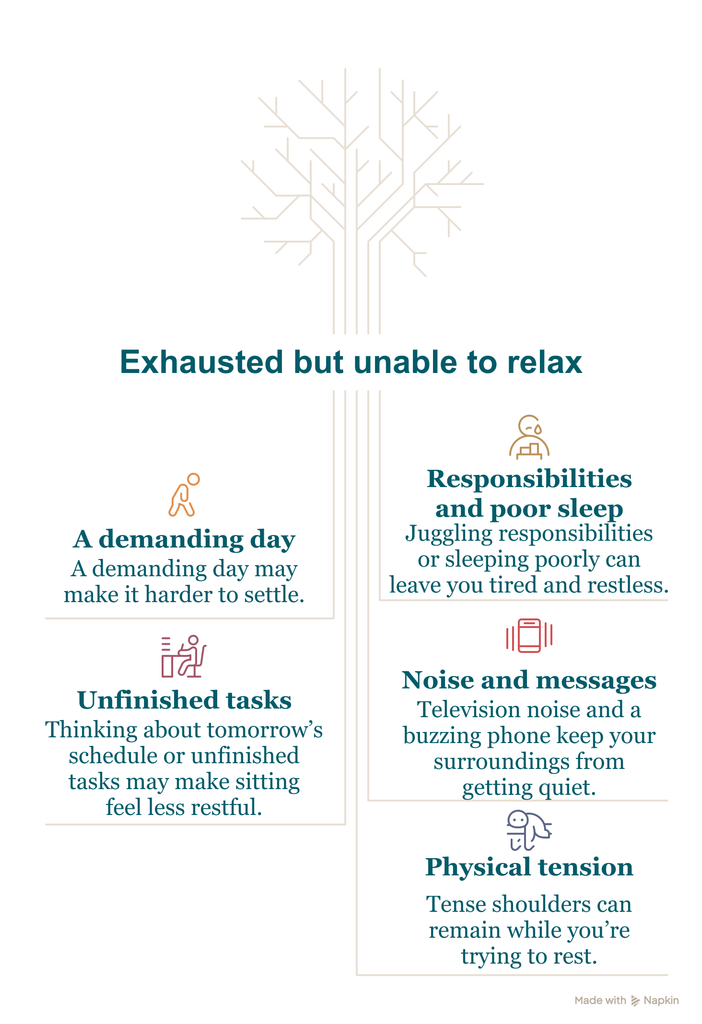
Maybe you turn on the TV and find yourself scrolling through your phone at the same time. Maybe you sit down and immediately start thinking about everything you didn’t finish. Or maybe you’re trying to rest, but your shoulders are still up around your ears.
Tiredness does not always equal the ability to settle down. When you’re exhausted but can’t settle, it can be hard to know what to do next.
Let’s make this make sense.
You can be tired and restless at the same time
When you’re exhausted, you might expect rest to feel easy. But having a few minutes to sit down doesn’t necessarily mean you can stop thinking about the day—or that your surroundings suddenly get quiet.
You may be managing chronic pain, juggling responsibilities, sleeping poorly, or simply coming off a day that asked a lot of you. Those experiences are different, and they don’t all have the same explanation.
The point is not to figure out the one reason you feel this way from a blog post. It’s to recognize what’s happening before you decide what you should do about it.
You’re tired. You’re also having trouble settling. Both can be true.
“Just relax” isn’t much of a plan
“Just relax” sounds simple enough. So does “clear your mind.” If only it were that simple.
Telling yourself to relax doesn’t tell you what to do when the television is on, your phone keeps buzzing, and you’re mentally reviewing tomorrow’s schedule.
On the other hand, deciding you need to push through and finish a few more things may not be the answer either. Neither is automatically right for every person or every evening.
Before you add another task—or get frustrated because you can’t seem to enjoy your break—take a look at the situation you’re actually in.
Start with one thing you can notice
You don’t need to examine every part of your day. Pick one thing that’s happening right now.
- Is there noise around you that you could turn down or step away from?
- Are you still looking at messages when you meant to take a break?
- Do your jaw or shoulders feel tense?
- Is your mind going through a list of things you think you should be doing?
You don’t have to answer all of these. One observation gives you a place to start.
Thinking about the difference between a “should do” list and a “could do” list helps me understand priorities.
“I should relax” can become one more thing you’re failing to accomplish. “I could turn off the TV for a minute and see how that feels” gives you something specific to try.
That doesn’t mean the TV is the problem. It means you’ve chosen one part of the situation you can change and check.
Try one small change—and see what happens
Let’s say you notice that the room is noisy and your shoulders feel tight.
First, notice the tightness. You can give it a number from zero to ten if that helps, or simply make a mental note.
Then try one change: turn off a source of noise or move somewhere quieter for a minute, if you can. You don’t need perfect silence, and you don’t need to make yourself relax.
Afterward, check your shoulders again.
- Do they feel any different?
- Do they feel about the same?
- Do you feel more uncomfortable?
You don’t have to make the answer come out a certain way. You’re checking, not taking a test you can pass or fail.
Should the change prove helpful, you may try it again. If nothing changed, you can leave it alone or try a different reasonable option later. If you feel worse, stop that experiment and return to what feels comfortable.
Good advice should change something you can notice. That doesn’t mean every idea will work for you. It means the response is worth paying attention to.
What about the things you still need to do?
Sometimes you sit down and your mind starts listing everything waiting for you. And the longer the list gets, the less restful sitting there feels.
Try writing the list down. Then ask yourself which item actually needs your attention now and which ones can wait.
You’re not trying to create the perfect schedule or finish the entire list before you’re allowed to rest. You’re separating what needs a decision from the noise of trying to hold everything in your head.
If one thing needs doing, choose the smallest next step. If it can wait, let the written list hold it for now.
When it’s time to ask for more support
A quieter room or a shorter list may be useful in a particular moment, but neither can tell you why you’re exhausted.
If your tiredness has been going on for a few weeks and you’re not sure why, or it’s affecting your daily life, talk with a qualified healthcare professional. New, severe, worsening, or concerning symptoms also deserve medical attention. You don’t have to sort it all out on your own.
Stop guessing what you need right now
The next time you’re tired but can’t seem to settle, you don’t have to choose between forcing yourself to do more and sitting there wondering why you can’t relax.
Notice one thing. Try one reasonable change. Then ask: What changed?
If you’d like a little guidance through that process, I made the Body Needs Decoder for moments like this. It helps you describe what you’re noticing, choose one thing to try for a minute, and check your response. It’s not a diagnosis or a promise to fix how you feel. It’s a way to get a little more information before deciding what to do next.
