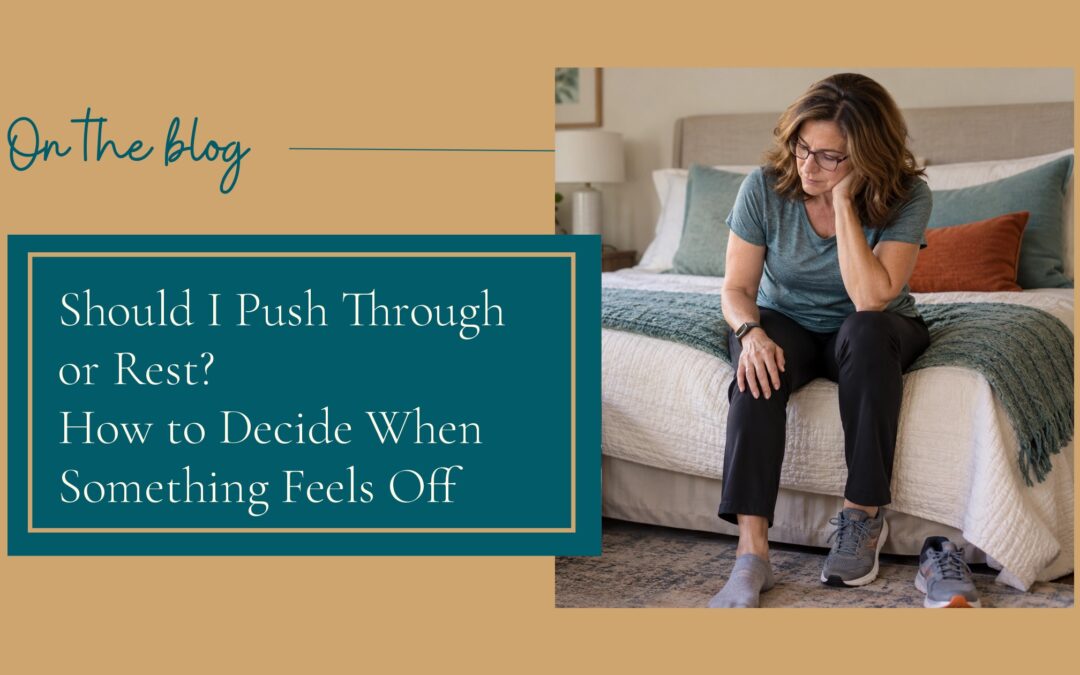
You planned to go to the gym, and now your knee aches, and you don’t know whether walking on it will help or make it worse.
You woke up foggy, can’t hold a thought for more than eight seconds, and there’s a whole day in front of you.
You finished a workout and felt worse afterward than you did before you started.
You’re tired and restless at the same time, and you can’t tell whether you need to move, lie down, or turn everything off for ten minutes.
Something feels off, and you have to decide what to do about it in the next few minutes. Not in six weeks. Now.
This article won’t tell you why your knee hurts or why your head won’t clear. It can’t diagnose anything, and there’s no single answer that fits every woman having this exact morning. What it will do is show you how to separate the signal from your first reaction, try one small thing, and check how your body responds.
Your brain makes the first move
When something feels off, your brain does not wait for a full investigation. It makes a fast prediction from what is happening now, what happened before, and what has usually worked well enough to get you through.
That decision can happen before your conscious, thinking brain has finished asking the question. Your muscles may tighten. Your movement may change. You may feel an ache, an urge to stop, or an equally strong urge to ignore it and finish what you planned.
Then the story arrives: This is an injury. I’m being lazy. I need to push through. I should stop completely.
The speed is useful. You would not want to hold a committee meeting before pulling your hand away from a hot stove. But the fastest answer is often the most familiar one, not necessarily the one that fits this moment. When you have slept poorly or are already carrying too much, careful thought takes more work.
Your brain has goals. Keep you safe. Conserve effort. Finish the plan. Avoid repeating something that went badly before. Your body carries out that response, often before you consciously choose it.
That does not make the signal imaginary, and it does not make the story true. It means you need to separate what you are feeling from the first explanation your brain handed you.
An ache is information, not an instruction
An ache is information. So is fog. So is fatigue, and so is that restless, can’t-settle feeling.
Information, not a complete set of instructions.
The feeling is real. The story your brain attaches to it may or may not be accurate.
Stop could mean there is an injury that needs attention. It could also be a familiar protective response because this movement hurt before, the class feels like too much today, or your brain has learned that stopping is the safest available answer.
Push through is a story too. It may come from a goal your thinking brain cares about: finish the workout, stay on schedule, prove you are consistent. That goal may have very little to do with what your body can use right now.
This is why the same feeling can call for different responses on different days. Feeling tired might mean rest would help. It might mean five minutes of easy movement would help more than lying down. It might mean you need fewer things coming at you for a few minutes. Less noise. Less screen. Fewer people needing an answer.
The question is not Which voice should I obey? It is What is happening right now, what story showed up first, and what can I safely test?
A protective response is not always a verdict
Say you take a HIIT class and it is more than your system can handle well that day. Your brain may respond by increasing muscle tension, changing how you move, or producing an ache that gets your attention. That does not prove the class damaged your knee. It also does not prove the pain should be ignored.
Knee pain can have many causes. A new injury, swelling, worsening pain, or anything that does not make sense needs a qualified assessment. But when there is no acute injury and the situation is appropriate to test, the first warning does not always have to decide the future of the whole plan.
You may need less range. Less load. Fewer rounds. A different time of day. One thing changed and the rest left alone.
Modification is not cheating. It gives you a way to find out whether the problem was the movement itself, the dose, the context, or something else you have not identified yet.
Before you scrap the plan, try the smallest reasonable version and pay attention to what happens. Baby steps are the best steps, and they are the only ones with a good chance of sticking.
Ask a question your body can answer
This part is shorter than you would expect.
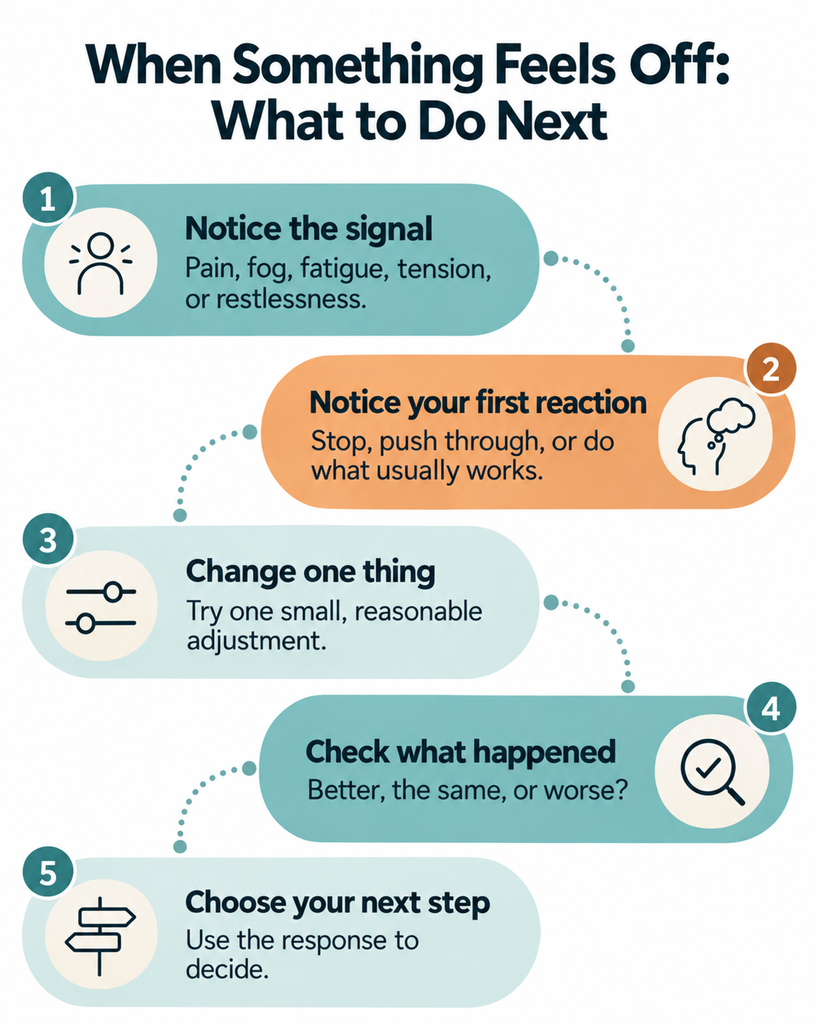
- Pause before you automatically push through or shut the whole day down.
- Describe what is happening right now, in plain language.
- Notice the first story your brain supplied.
- Change one thing and check the response.
The describing step is the one most of us skip, and it does the work. Keep it to what you can actually observe right now:
- My knee aches when I start walking, but I haven’t checked whether it changes after a few easy steps.
- I feel foggy and my eyes keep drifting off the screen.
- I’m exhausted and restless at the same time, and I can’t settle into either one.
Then notice the story: I should stop. I have to finish. This always happens. Movement will make it worse.
Do not argue with it. Just stop treating it as a fact before you have checked it.
Now ask a question your body can answer. You may not do anything to the knee at all. You might slow your breathing, turn down the lights, step somewhere quieter, or change another part of the situation that seems completely separate from the ache.
Why would that tell you anything about your knee?
Because pain is not shaped only by what is happening in one joint. Your brain is also weighing context, prior experience, and how much protection it thinks you need. If the ache changes after you alter something away from the knee, you have not proved why the knee hurt. You have learned that the experience can change when something outside the knee changes.
That is the body’s “honest” answer, with an important qualification. It is not a diagnosis or a perfect verdict. It is an observable response you did not have to argue yourself into. Your body gave you new information. Now your thinking brain can use it.
Pick one thing to try:
- Rest or recovery.
- A smaller or modified version of what you planned.
- One short breath-and-body exercise.
- Changing what is around you. Quieter, brighter, dimmer, or simpler.
- Getting a qualified assessment when something is new, worsening, or does not make sense.
One at a time. This is the part people rush.
If you rest, change the lighting, take a supplement, skip lunch, and stretch for ten minutes all at once, and you feel better, you have learned nothing about what helped. Next Tuesday you will be guessing again.
Let the response tell you what comes next
After the one thing you tried, check in:
- Did the tension, fog, discomfort, or restlessness ease up?
- Did it stay exactly the same?
- Did it get worse?
All three are useful. If nothing happened, that may not have been what you needed right now. If it got worse, do not do the same thing harder. You have new information, and the next decision should use it.
This is where you bring the fast brain, the thinking brain, and the body’s response back into the same conversation. You are not blindly obeying the first alarm or using a goal to bulldoze it. You are checking what actually happened.
Good advice should change something you can notice. What changed? That is the part that matters.
Notice what is happening. Notice the story. Try one small thing. Check what changed.
When this isn’t a self-test
This is a way to make a clearer next decision. It isn’t a diagnosis, and it isn’t the right tool for everything.
Some things aren’t yours to sort out alone: a fresh injury, unexplained symptoms, real illness, chest pain, trouble breathing, anything neurological. If something is new, getting worse, or doesn’t make sense, get a qualified assessment.
The point was never that movement always wins, or that you can think your way through anything. The point is to make a better next choice in the ordinary moments when a short, careful test makes sense. Knowing which kind of moment you’re in is part of the skill.
Why I built the Body Needs Decoder
I work with women over 40 whose bodies stopped responding the way they used to. The workout that used to help now leaves you more wiped out than better. The diet that used to work does not move anything. Some days there is pain or tightness for no clear reason, and the energy drops out by mid-afternoon.
The problem is not only that you do not know what your body needs. Your brain has probably already supplied an answer.
Push harder. Stop completely. Find a new plan. Eat less. Do the thing that worked last time.
That answer may be trying to protect you, conserve effort, or keep you on track toward a goal. It may also be based on an old situation, a familiar habit, or incomplete information.
Almost every plan starts with instructions for the workout or the food. The layer above that is the part I care about: how your brain is interpreting what is happening, what response it is asking your body to produce, and whether that response actually helps now.
That is why I built the Body Needs Decoder. Not to give you another routine, but to help you slow down the automatic answer long enough to ask better questions: What is going on with me right now? What story did my brain attach to it? What is one small thing worth trying? How will I know if it helped?
You may never find out exactly why your knee hurt today. You can still make a better decision than the first automatic answer.
Not sure what you’re working with right now?
If you honestly can’t tell whether you need to move, rest, or change what’s going on around you, that’s the moment the Body Needs Decoder is built for.
It takes about two minutes. You name what’s going on with you. It tells you what your body is doing and why. You try one short thing, then check whether anything actually changed.
It won’t diagnose your pain, your fatigue, or why a bigger plan didn’t work. It’ll help you stop guessing long enough to take one useful step.
Something feels off right now. Go find out what your body is telling you.
