You have a workout plan. You show up. Efforts to stay consistent continue. But if you’re honest, you’re not sure it’s actually working.
Then another plan pops up in your feed, promising better results in half the time. (They always do.) And you think, Huh. Maybe this one’s better. Maybe I should switch.
But would you actually be better off? Or would you just have a new set of rules to second-guess? How would you even know?
Or it’s the end of the day and you’re completely frazzled. Work ran long, someone needs a ride, the dog threw up on the rug, and now everyone wants to know what’s for dinner. You’re standing in front of the open fridge with no idea what to make. The leftover casserole is staring back at you like it knows it’s about to make its third appearance this week.
Or your workout is on the calendar, but you’re too drained to do it and too restless to sit still. So you do neither, and then you feel bad about that too.
Three different moments. Same question underneath: what would actually help right now?
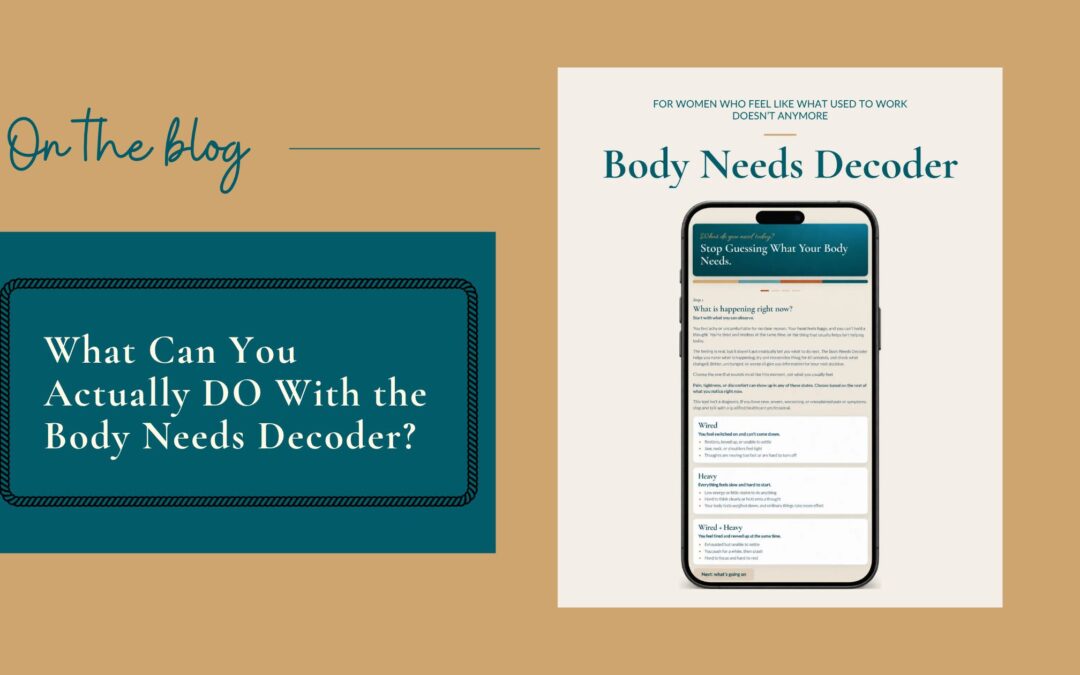
I made the free Body Needs Decoder for exactly that question. Here’s how it works, step by step, using those three moments as examples.
What the Body Needs Decoder is, and what it isn’t
The Decoder is a free, interactive online tool. It’s not a workout. It’s not a PDF you save and never open again. (We all have that folder.)
It takes a few minutes. You name what’s happening right now, try one small thing for 60 seconds, and check what changed.
It won’t diagnose anything, and it won’t tell you why you feel the way you do. What it gives you is information, so you’re not guessing before you decide what to do next.
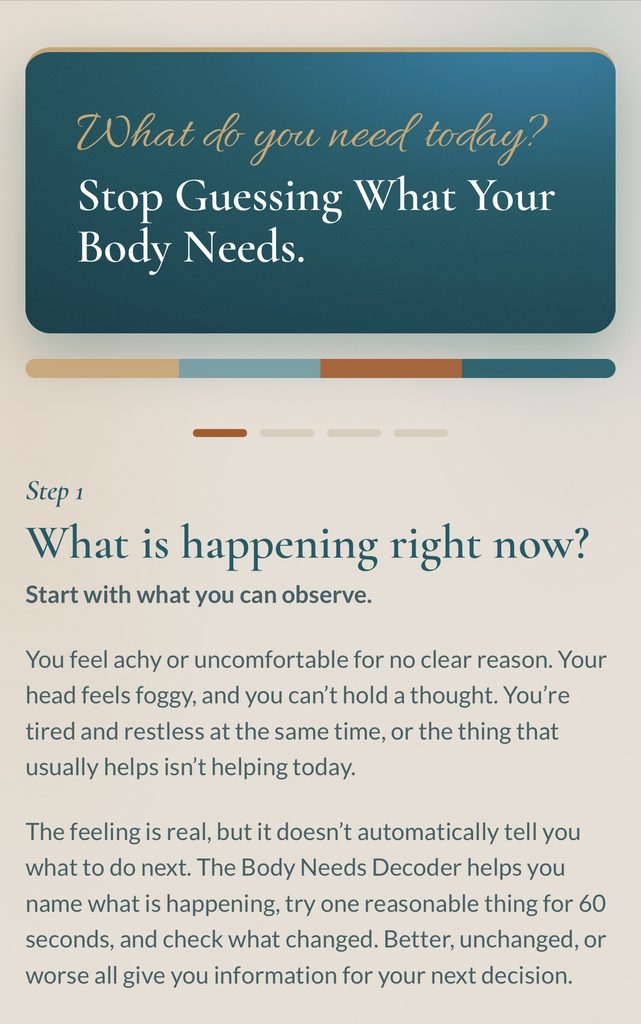
Step 1: Choose what sounds most like right now
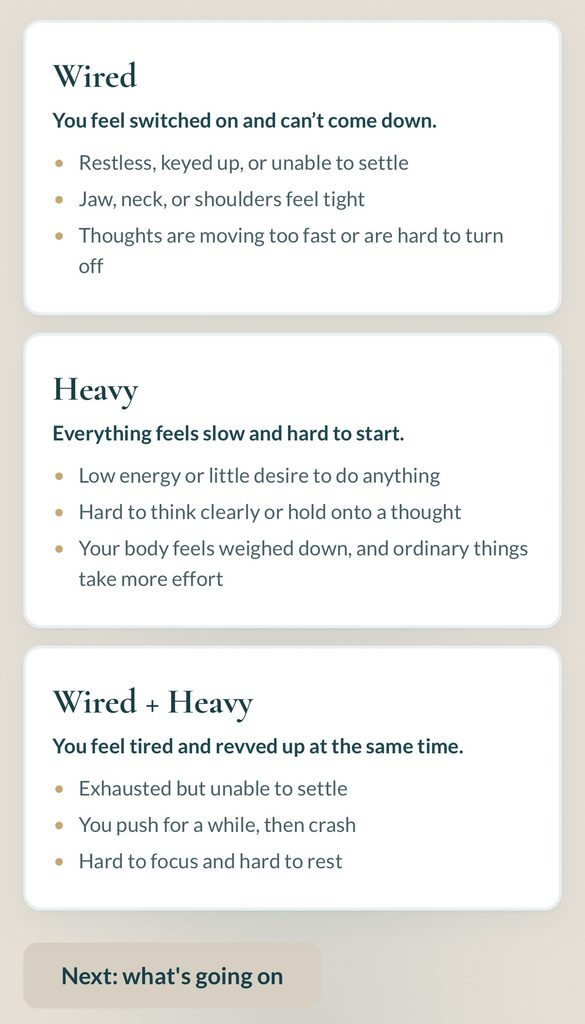
You’ll see three descriptions:
- Wired: You feel switched on and can’t come down.
- Heavy: Everything feels slow and hard to start.
- Wired + Heavy: You feel tired and revved up at the same time.
Choose the one that sounds most like this moment, not how you usually feel. Pain, tightness, or discomfort can show up with any of them.
The situation doesn’t pick for you. Two women standing in the same kitchen at 6 p.m. could choose different answers. Go with what you actually notice.
Step 2: Rate two things
Next, you rate your physical discomfort (aching, tightness, or tension) and your mental fog (how hard it is to think clearly or hold onto a thought), each from 0 to 10.
Your best estimate is enough. This is your starting point. There’s no right answer, and nobody’s checking your math.
Step 3: Try one thing for 60 seconds
Based on what you chose, you’ll see a short menu of options. For example:
- Wired: a breathing option (in for 4, out for 6), cutting screen glare, or cutting one source of noise
- Heavy: a minute of movement, facing a window or brighter light, or pressing your feet and hands down steadily
- Wired + Heavy: a breathing option, cutting the glare, or the steady-pressure option
Pick whichever one is most practical where you are. Get set up, then do it for the full minute. Keep it comfortable, and stop if something feels wrong or the breathing makes you lightheaded.
You’re not trying to fix your whole day in a minute. You’re changing one part of the situation so you can see how your body responds.
Step 4: Rate the same two things again
When the minute is up, you rate physical discomfort and mental fog again.
Don’t try to make the numbers improve. You’re recording what happened, not taking a test.
What this looks like in real life
Here are the three moments from the beginning. The state each woman chooses is an example. You might choose differently, and that’s the point.
The new workout plan that makes you doubt yours
You were fine with your plan until this morning. Then you saw the new one, and now your brain is running a side-by-side comparison while your shoulders creep up toward your ears.
Say you choose Wired. You rate your discomfort and fog, then pick the breathing option: in for 4, out for 6, following the circle on the screen for a minute. Then you rate again.
Maybe your shoulders feel a little looser. Maybe nothing changed. Either way, you know something about this moment that you didn’t know a minute ago.
The Decoder won’t tell you which plan is better. That’s a separate question, and it’s a lot easier to think through when you’re not answering it wound up. And if your approach so far has been to add something every time a new plan shows up, how’s that working out for you?
Dinnertime, and one decision too many
It’s 6 p.m. You’ve made roughly four hundred decisions today, and now you’re standing in front of the open fridge like the answer might be written on the yogurt. You don’t want to dump leftover casserole on your family again. You also don’t have it in you to make anything that requires a recipe.
Say you choose Heavy. You rate your two numbers, then pick the movement option and clear the counter for a minute. Enough movement to notice, not a workout. Then you rate again.
One minute won’t cook dinner. (If it does, please tell me how.) But it might make the next decision a little easier to see. Maybe that’s eggs and toast. Maybe it’s the casserole after all, and that’s fine too. Or maybe nothing changes. Either way, you still need to eat. The Decoder isn’t a substitute for a meal, and feeling worn out isn’t a reason to skip one.
The workout you planned and can’t face
Your shoes are by the door, and they’re judging you. You’re drained, but you’re also too restless to sit on the sofa and do nothing. Neither option feels right, so you hover somewhere in between.
Say you choose Wired + Heavy. You rate your numbers, then pick the steady option: both feet on the floor, hands pressing into your thighs, steady pressure, breathing normally for the full minute. Then you rate again.
Now you’re deciding with more information. A shorter or easier version of the workout may make sense today. Maybe a walk does. Maybe rest does. The Decoder doesn’t make that call for you. It gives you something real to base it on, instead of guilt or habit.
If you’re often torn between pushing through and resting, I wrote more about that decision in Should I Push Through or Rest?
What your results actually mean
At the end, you’ll see what changed. Each result means something different:
- Both numbers came down. Changing one thing created a response you could notice. It doesn’t explain why you felt off, but it’s worth remembering for next time.
- One number came down. That mixed result is still useful. The experiment changed part of what you noticed, not all of it.
- Nothing changed. You didn’t fail. That option may not be useful right now, or the response was too small to notice. You can try another option.
- A number went up. Don’t repeat that experiment right now. Return to what feels comfortable.
Better, unchanged, and worse are all information. The feeling is real. Your first explanation may not be the whole answer.
You’ll also see your Body Needs Starter Map: what you noticed, what you tried, and what changed. You can request a copy by email so you can look back at it later.
When you need more than a one-minute check
If you live with chronic pain, deciding what to try can be complicated. The Decoder can help you test one small thing and check how you respond. It doesn’t treat pain or tell you what’s causing it.
If you have new, severe, worsening, or unexplained pain or symptoms, stop and talk with a qualified healthcare professional.
Start with one moment
The next time you’re second-guessing your workout plan, negotiating with the casserole, or hovering between your workout and the sofa, you don’t have to guess.
Notice what’s happening. Try one thing. Then ask: What changed?
Try the free Body Needs Decoder
Enter your email on that page and confirm your address to open the Decoder. You’ll also get an access email with a link, so you can come back to it whenever something feels off.
